
Six dental clinic websites in Madrid, measured on 27 August 2026 with our analysis tool. As with the rest of these studies: six is not a representative sample, and we say so before giving any number.
We expected to find what we found in other sectors. We did not.
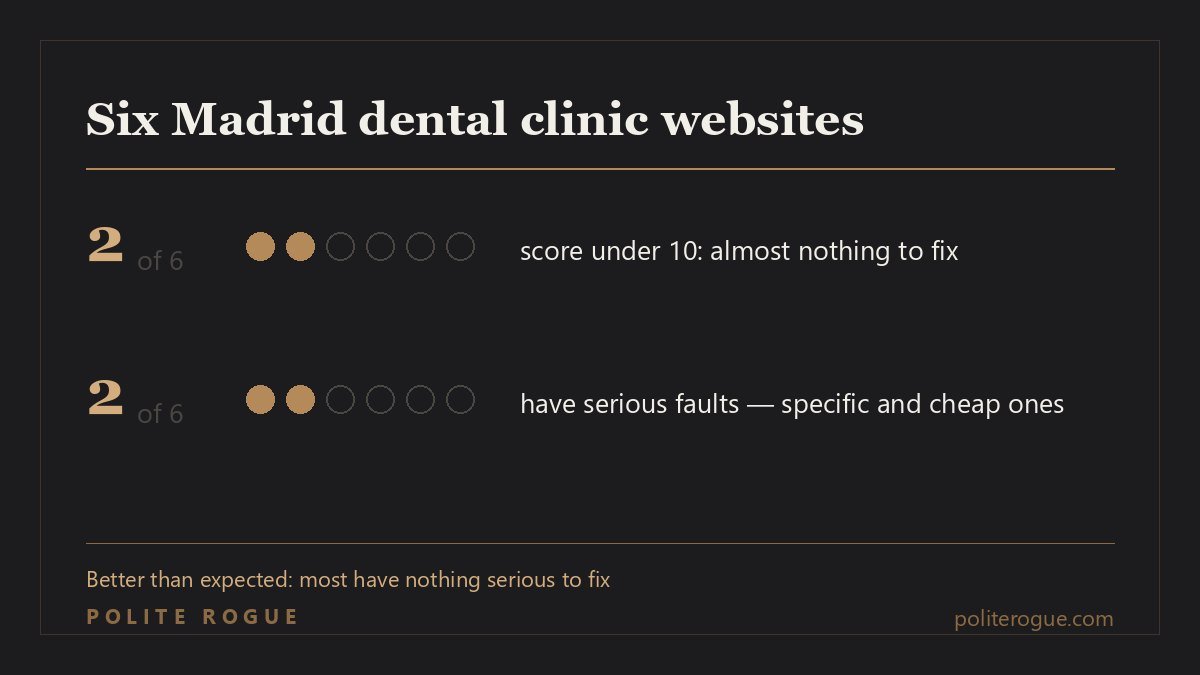
The numbers
The average was 23 problem points
Roughly half of other sectors we have measured with the same tool and the same criteria. Two of the six came in under 10 points, which is effectively a site with nothing to fix.
All six are mobile-adapted and all six have a security certificate
That may sound like a baseline, but it is not: in other sectors we measured, it does not hold. In dentistry, the investment in the website appears to have been made.
Only two of six had serious faults
And in both cases they were specific, cheap things rather than a deep problem: on one, a phone number written but not tappable on mobile; on another, signals of a site untouched for years.
None of the six is in more than one language
The only fault shared by all six. In a city with Madrid's foreign population, and for a service people search for urgently, it is the clearest opportunity in the group.
A sector doing well does not mean there is no work. It means the work is no longer fixing what is broken, but winning at what nobody is doing.
What this tells us
In a sector where almost everyone has done the basics, the advantage is no longer in having a website: it is in the details that decide a phone call. That the number dials when tapped. That Google knows your hours without guessing. That a foreign patient finds you in their language.
It is the exact opposite of sectors where half fall short, and it completely changes the conversation to have.
How to check yours
The tool we used is public and free, with no sign-up. And if you want the number that actually persuades, compare your site against three direct competitors: it will tell you where you are the only one falling behind.